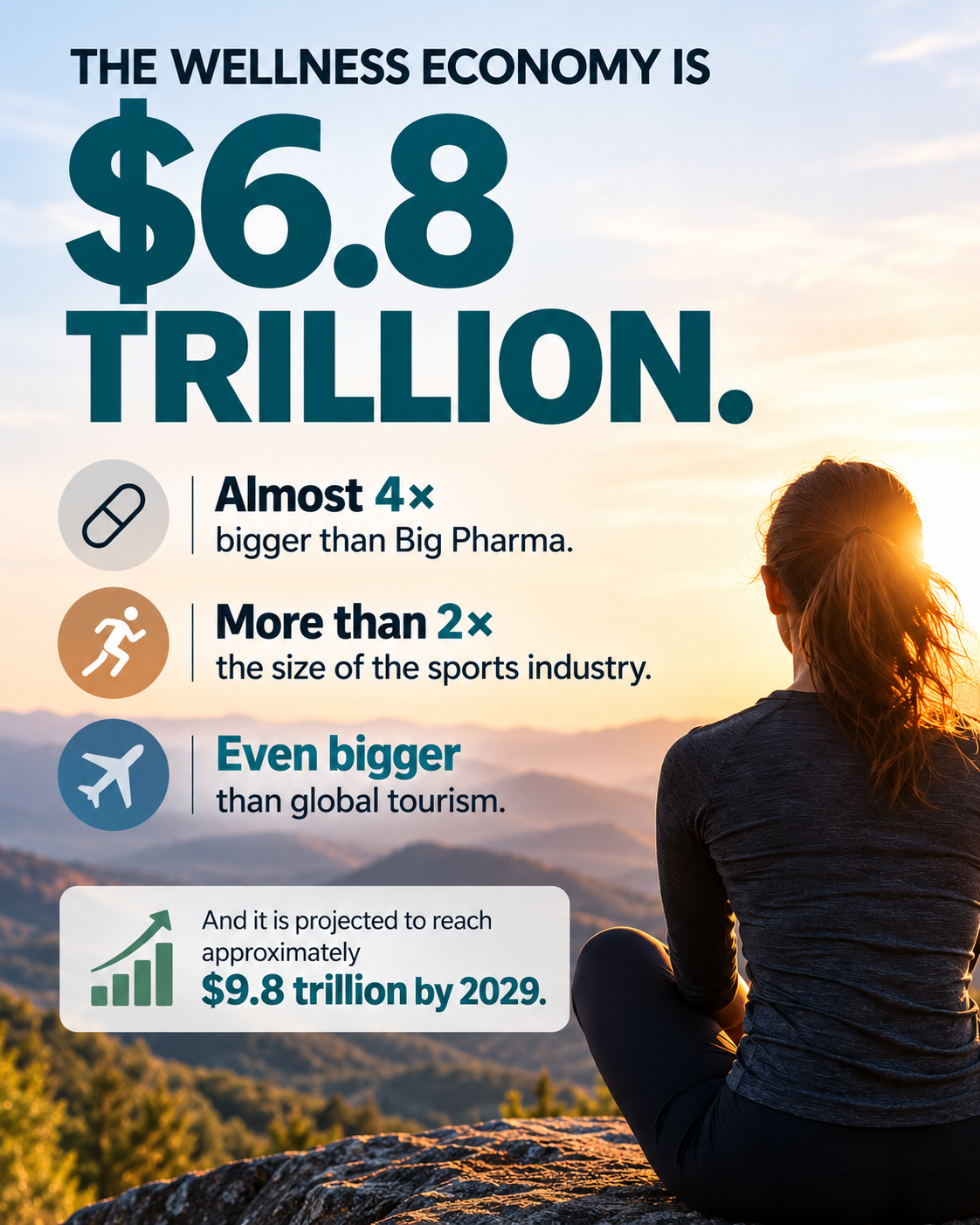
THE WELLNESS ECONOMY IS
$6.8 TRILLION.
Almost 4× bigger than Big Pharma.
More than 2× the size of the sports industry.
Even bigger than global tourism.
And it is projected to reach approximately $9.8 trillion by 2029.
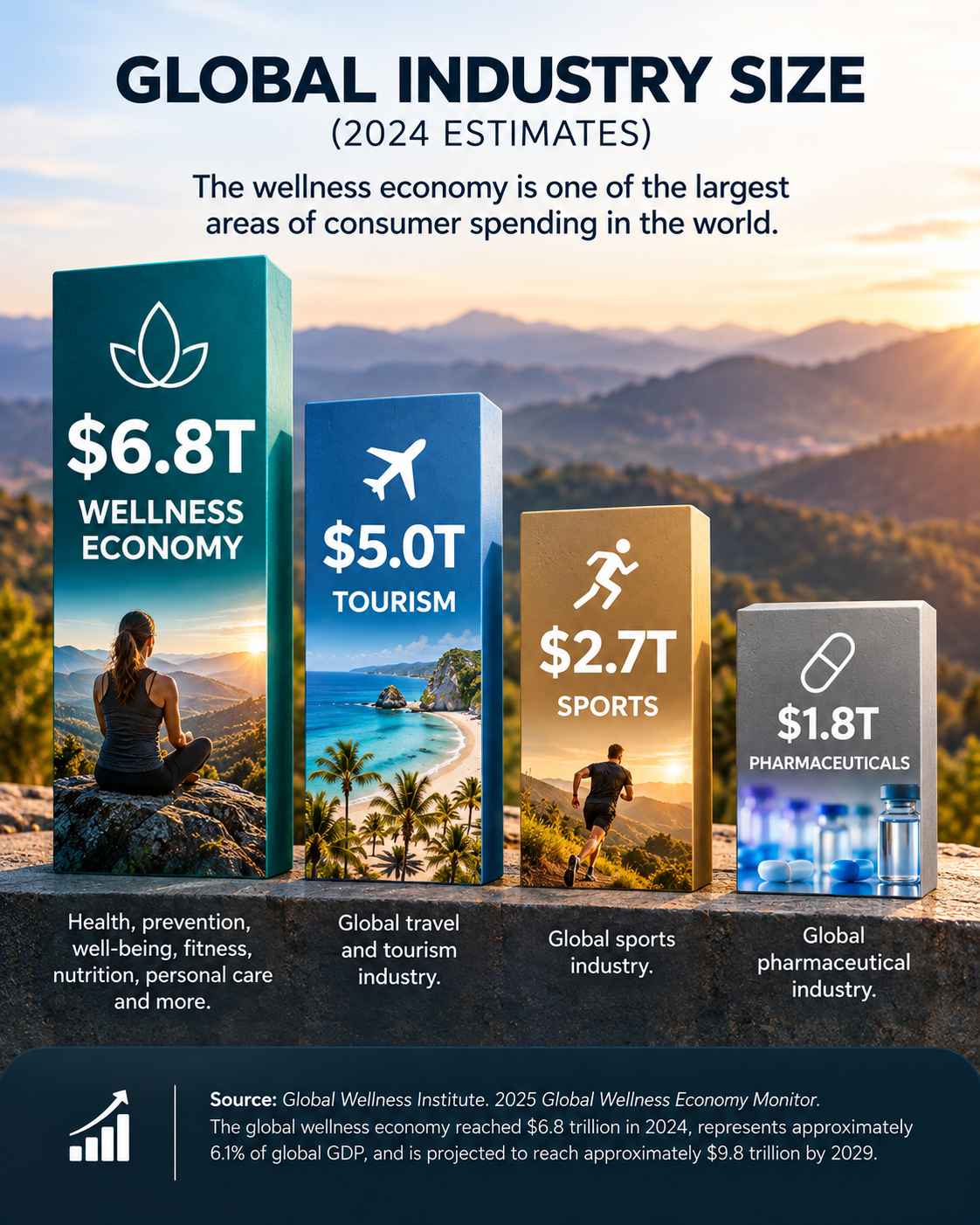
Wellness Has Become One of the Largest Consumer Economies in the World.
According to the Global Wellness Institute, the wellness economy reached $6.8 trillion in 2024 and represented approximately 6.1% of global GDP.
Wellness Is Being Prioritized
Across Generations.
The opportunity isn't being driven by one age group. Younger generations are putting more attention and money into wellness while an enormous older population is moving into years where staying active and capable matters more than ever.
Younger consumers are helping drive wellness spending.
Gen Z and Millennials represent approximately 36% of U.S. adults but account for more than 41% of annual wellness spending.
Source: McKinsey, Future of Wellness 2025
At the same time, America is getting older.
Roughly 10,000 Baby Boomers have been crossing the age-65 threshold each day, with the entire Baby Boomer generation reaching age 65+ by 2030.
Source: U.S. Census Bureau
Different Ages. Different Goals.
Same Human Body.
A younger athlete may want to perform with less unnecessary effort. A busy professional may want less tension and easier breathing. Someone beginning fitness may want a more approachable way to move. An active older adult may want to remain mobile, capable and independent.
CALATA isn't built around an age.
It's built around something much more universal: learning what your body is doing in real time so you can move, exercise and breathe with less unnecessary tension and more ease.
Think About the People Already Walking Through a PT Clinic's Doors.
They aren't all the same age. They aren't all at the same level of fitness. And they aren't all trying to accomplish the same thing.
But many of them want some version of the same outcome: move better, stay active, feel better, remain capable and keep doing the things they love.
Those motivations don't disappear when physical therapy ends.
Yet the traditional PT business model generally participates in only a relatively small window of that person's life.
Their relationship with their body doesn't.
And I think that's where a significant opportunity exists.
There's a Missing Middle.
Between traditional rehabilitation and traditional fitness is a large population of people who simply want to keep moving, feel better and function well.
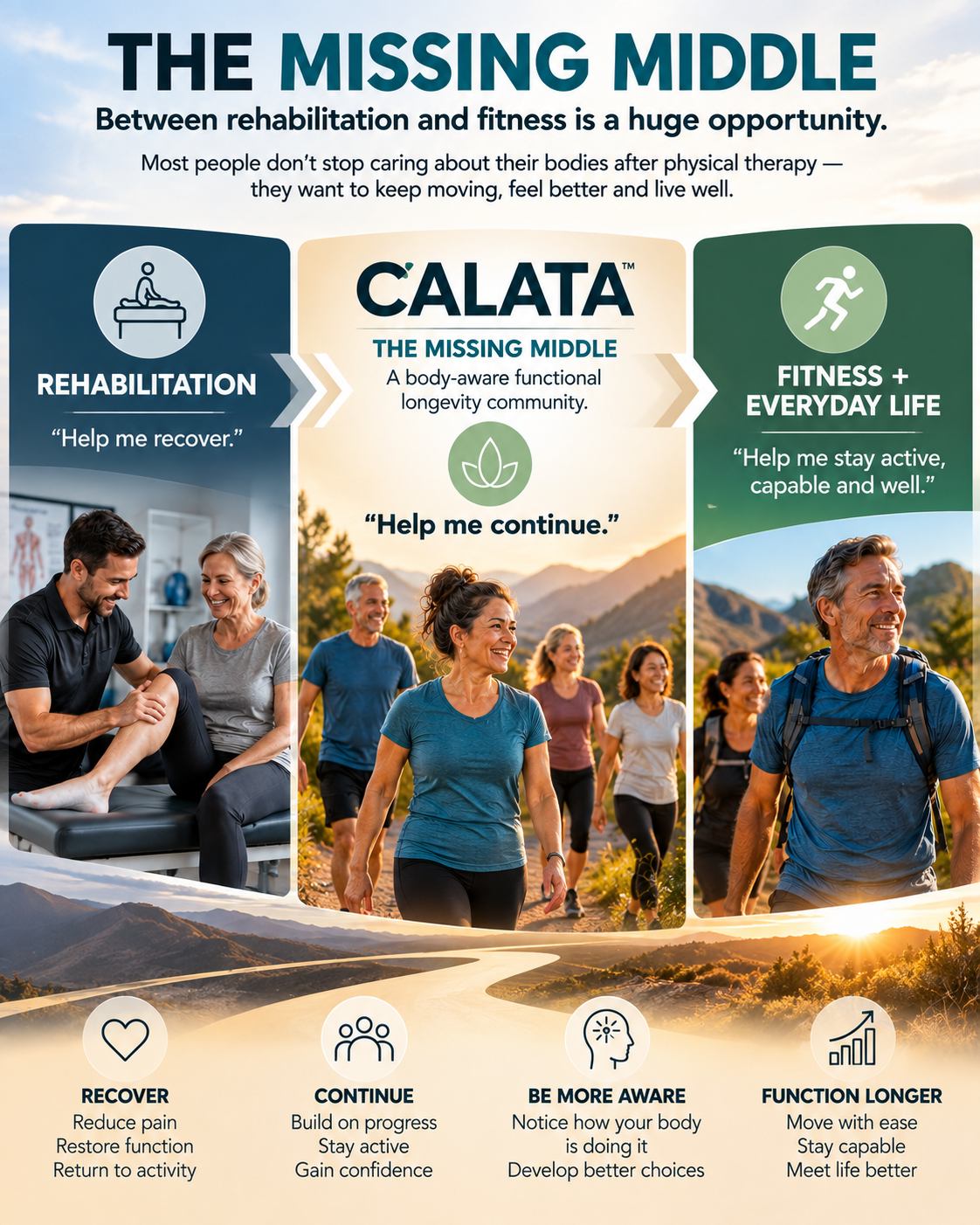
“PT clinics should offer wellness.”
The bigger question is:
THAT MAKES IT EASY FOR THEM TO DO IT?
That's what I'm building.
CALATA
A body-aware movement and wellness method built around a deceptively simple question:
Most movement and exercise programs naturally focus on: What are you doing?
CALATA adds another layer: How is your body doing it?
How much effort are you using? Where are you unnecessarily bracing? What happens when you're concentrating, exercising, rushing, working, talking, stressed or tired?
And what changes when you begin recognizing those responses while they're actually happening?
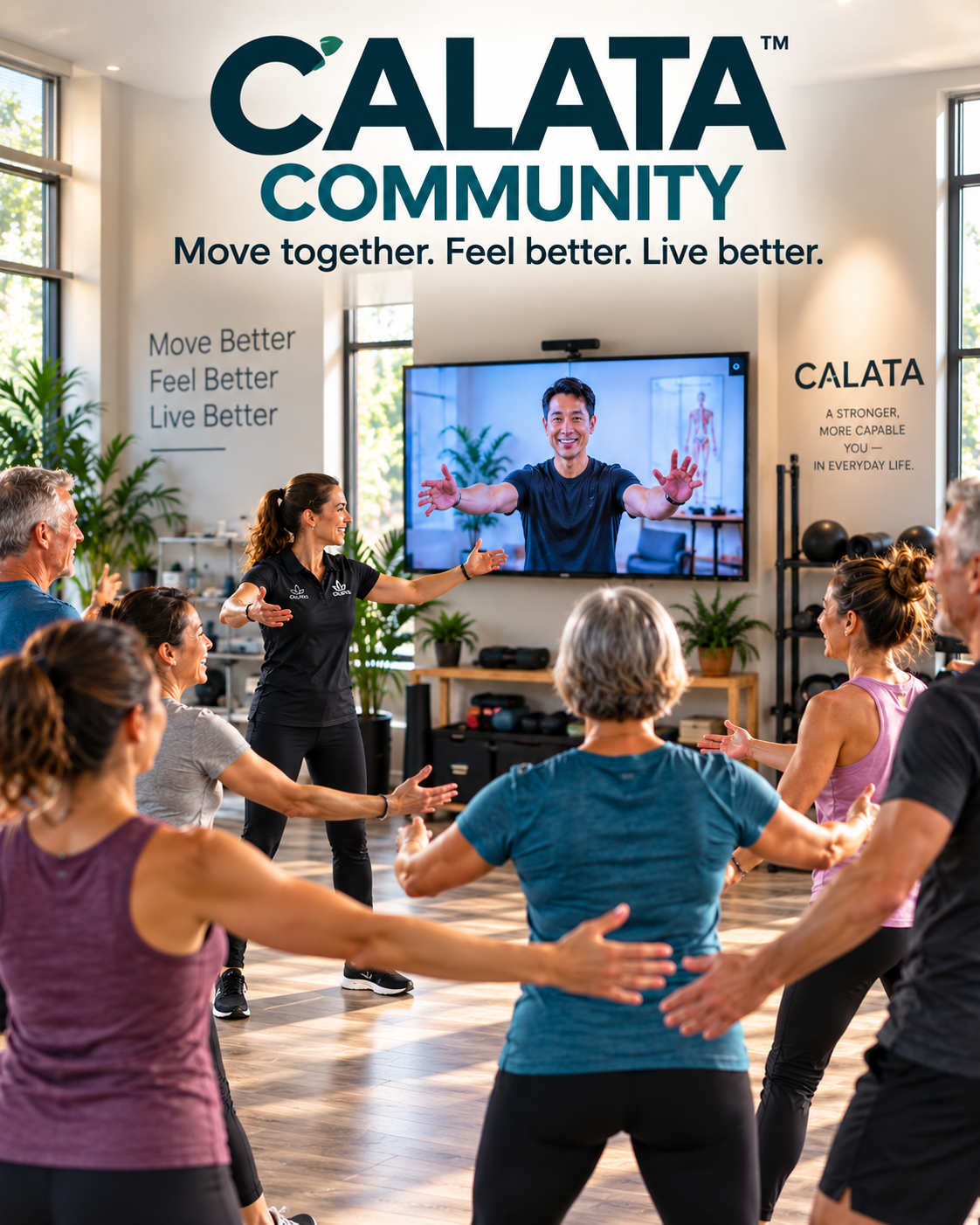
We're Building a Community Around It.
People move. Explore. Learn. Notice. Interact. Practice. Come back.
The objective isn't simply to teach CALATA. It's to create an experience people find valuable enough to return to—and eventually bring someone else into.
This Is Where I Think It Gets Really Interesting.
A PT clinic already has much of what would be extremely difficult for a traditional wellness startup to create.
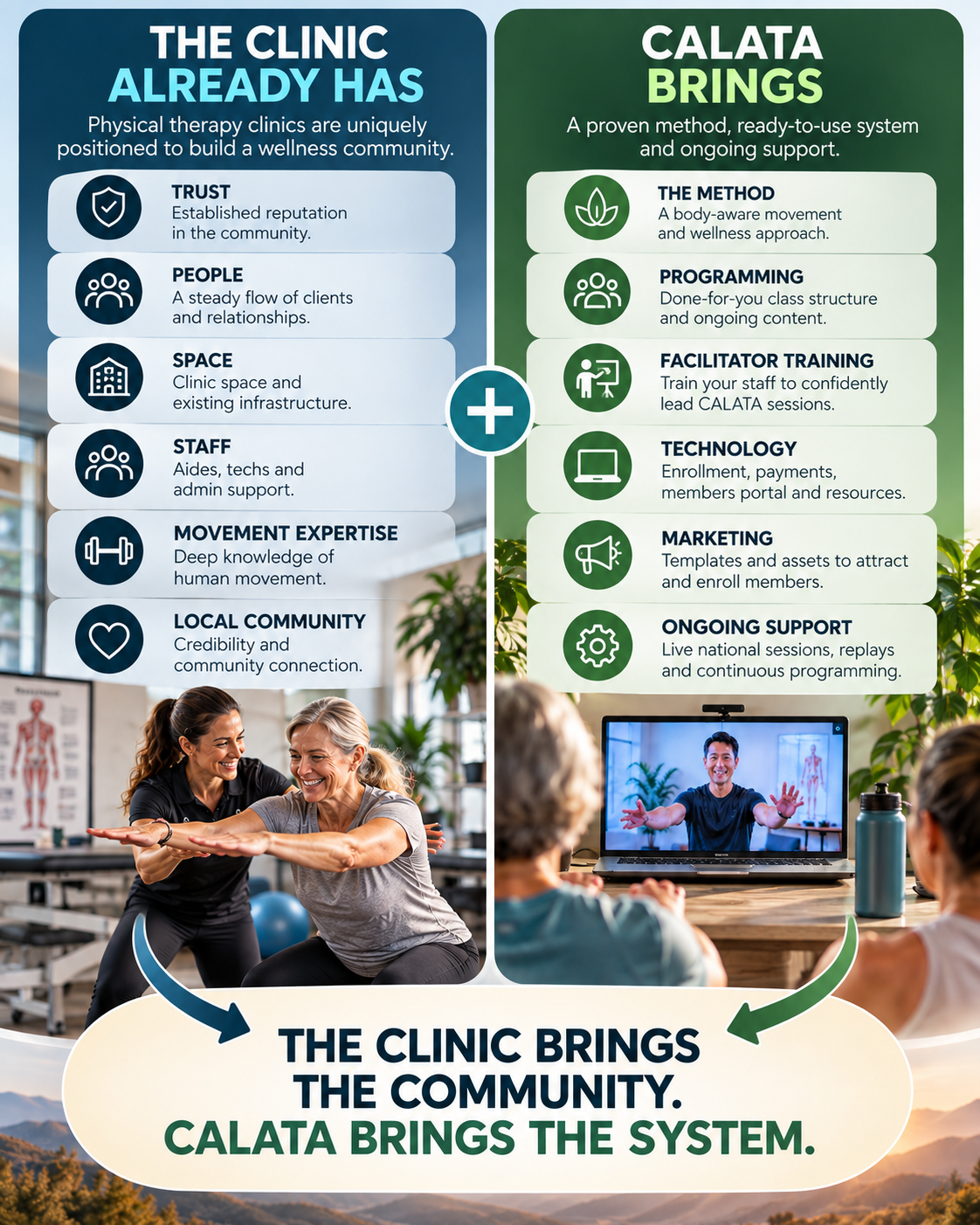
CALATA BRINGS THE SYSTEM.
Instead of hundreds of independent clinics each trying to figure out how to create, market and operate their own wellness community...
We build the infrastructure once and create a system clinics can bring into their own communities.
One Method.
Different Communities.
CALATA doesn't have to look exactly the same in every community.
The method stays consistent, while the culture surrounding it can reflect the people a clinic already serves.
Active Adults & Athletes
A sports-oriented clinic might build a CALATA community around active adults, runners or recreational athletes who want strength and performance without carrying unnecessary effort.
People New to Fitness
Another clinic might create a welcoming community for people who want to become stronger and more active but don't identify with traditional fitness culture.
Midlife & Longevity
A clinic may naturally attract adults focused on maintaining mobility, strength, independence and participation as they get older.
Everyday Tension & Capacity
Another community may attract busy adults who notice tension, bracing and effort accumulating during work, exercise and everyday life.
THE CALATA METHOD REMAINS THE CENTER.
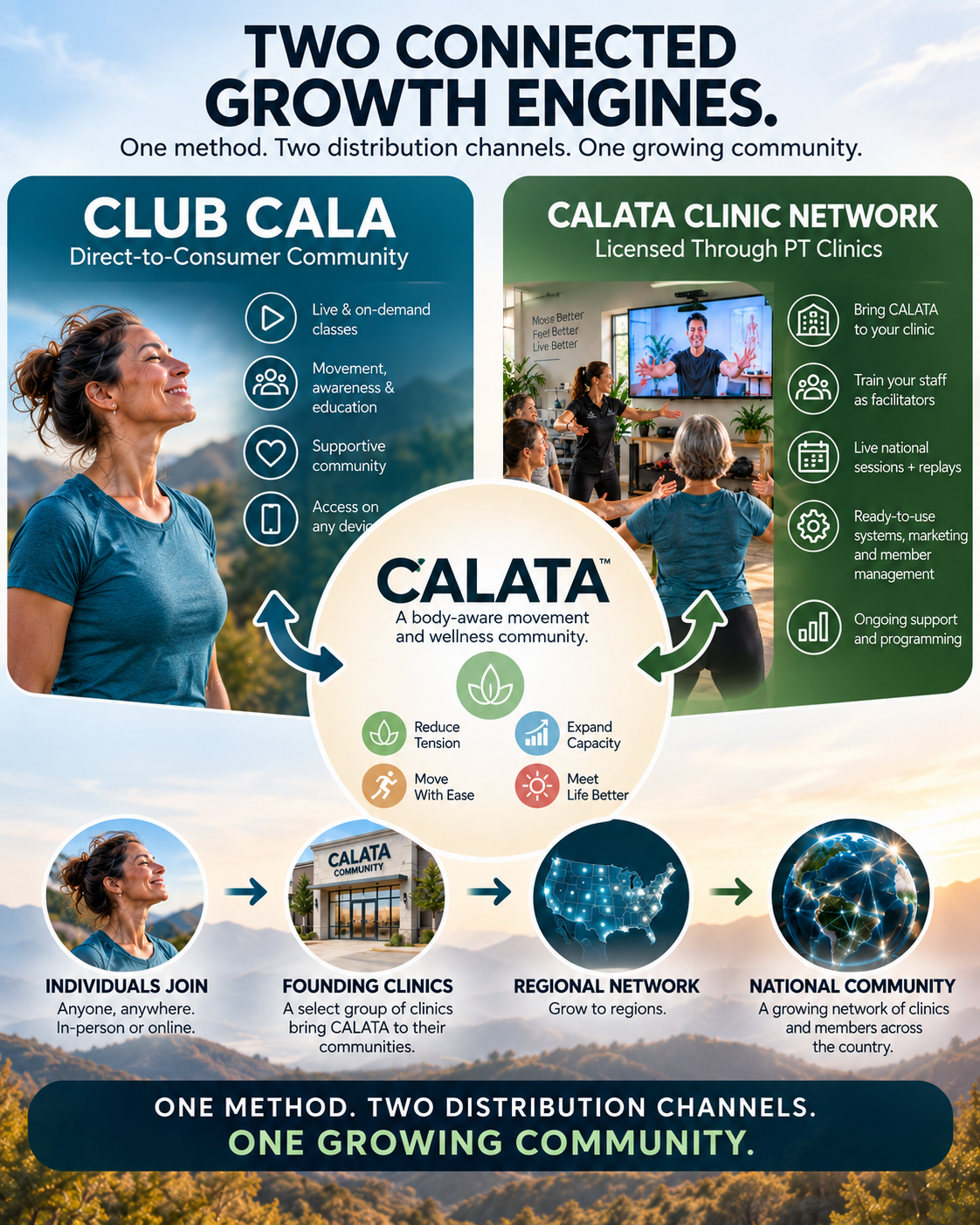
Two Connected Growth Engines.
CALATA isn't dependent on a single way of reaching people.
CLUB CALA
Individuals can discover CALATA directly, join the community and participate in an ongoing membership.
CALATA CLINIC NETWORK
PT clinics license the system and bring CALATA into communities where trust and relationships already exist.
I Don't Want to Simply Create Another Wellness Class.
I want to build the infrastructure that allows physical therapy practices to participate in this growing wellness economy without having to invent the infrastructure themselves.
At the same time, we're building a consumer community around a method that can extend far beyond physical therapy clinics.
TWO DISTRIBUTION CHANNELS.
ONE GROWING COMMUNITY.
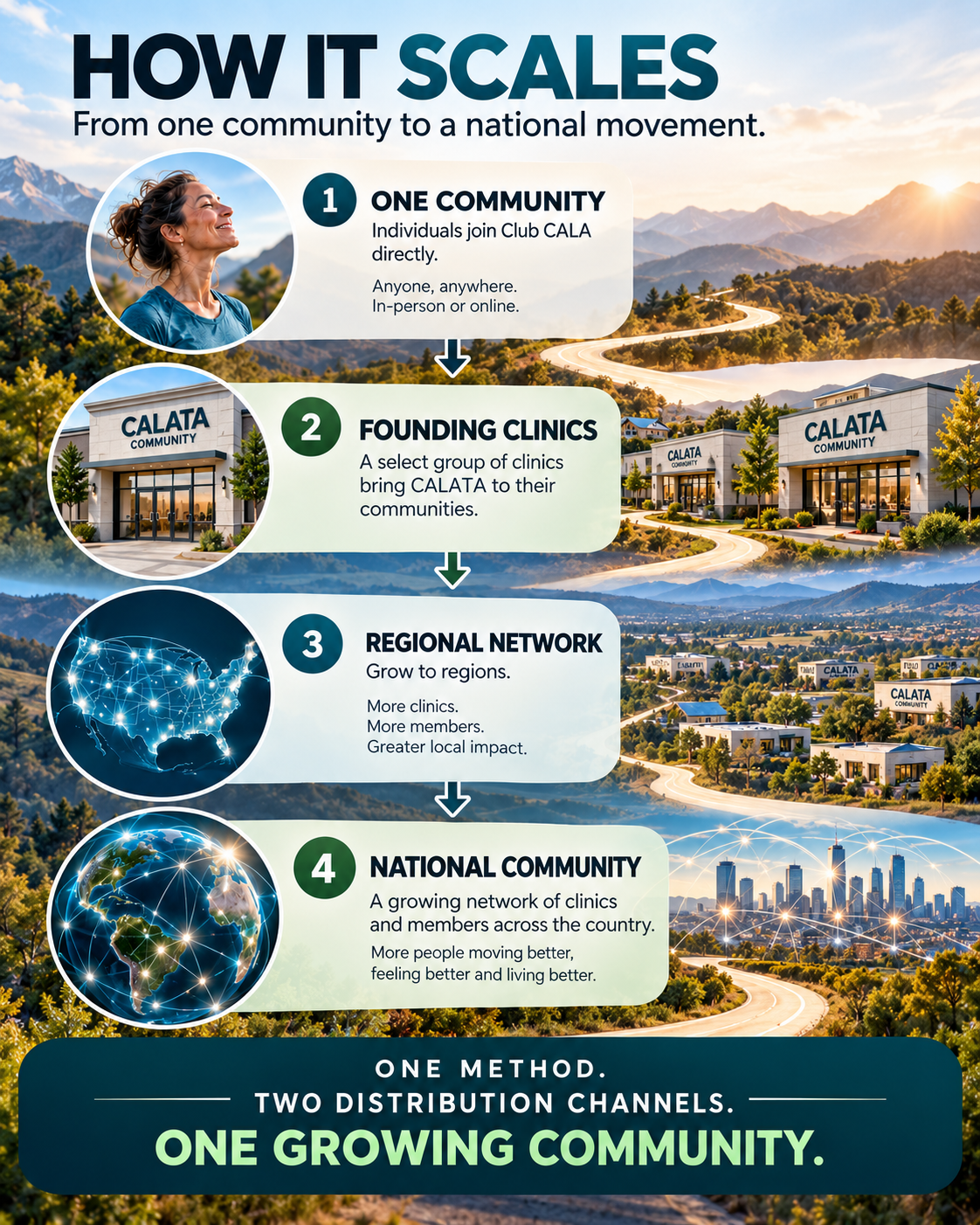
Start Small. Learn. Prove It. Then Expand.
The vision isn't to open hundreds of locations ourselves. It's to build a method, community and system capable of traveling through existing trusted relationships.
I'm Building This.
CALATA isn't something I'm trying to decide whether to pursue.
I can build it slowly—one community, one clinic and one relationship at a time. And I will if that's what it takes.
But I'm now considering what happens if I put the right people and enough initial capital around it from the beginning.
Not to spend recklessly. And not to manufacture growth before we've earned it.
But to allow me to put my full attention on the work I believe I do best.
The method.
The member experience.
Working directly with people.
Learning what makes them come back.
Learning what makes them tell someone else.
And continually making CALATA better.
While the right people build the operating, technology, marketing and clinic infrastructure around it.
Shane, This Is Where You Come In.
You know our circle about as well as anybody.
You know the people behind the resumes and bank accounts.
Who thinks long-term. Who understands business. Who handles uncertainty well. Who could bring something valuable besides money.
And probably just as importantly...
You know the people I'd actually want around the table with me if this becomes what I think it could become.
I'm not asking you to sell this to anybody.
I'm not asking you to raise money for me.
And I'm definitely not asking you to send this to everybody we know.
I'm asking for your judgment.
After you've looked through this, there's really only one question I want to ask you:
Not necessarily the people with the most money.
The right people.
The few people you think I should personally sit down with and show what I'm building.
That's where I'd like to start.
Sources & Context
Global wellness economy size, growth, share of global GDP and 2029 projection.
Comparison of the wellness economy with tourism, sports and pharmaceuticals.
McKinsey research found that 82% of U.S. consumers consider wellness a top or important priority in their everyday lives.
McKinsey reports that Gen Z and Millennials represent approximately 36% of the U.S. adult population while accounting for more than 41% of annual wellness spending.
The Census Bureau reports that roughly 10,000 Baby Boomers per day have been crossing the age-65 threshold and that by 2030 all Baby Boomers will be at least 65 years old.
APTA discussion of noncovered services including fitness, wellness, health promotion, prevention, educational programs, memberships and classes.
Market comparisons use Global Wellness Institute category definitions and estimates. They illustrate the scale of the broader wellness economy and are not intended to imply that CALATA addresses the entire $6.8 trillion market. The Baby Boomer statistic refers to people crossing the age-65 threshold, not necessarily retiring at that age.

Human-Centered Health Systems
Copyright 2026. KOHEALTH LLC - Privacy Policy | Terms of Service | Contact